The Opinion Factory: When Everyone's Voice Becomes No One's Wisdom
We've democratized opinions without requiring knowledge, drowning expertise in a sea of uninformed hot takes.
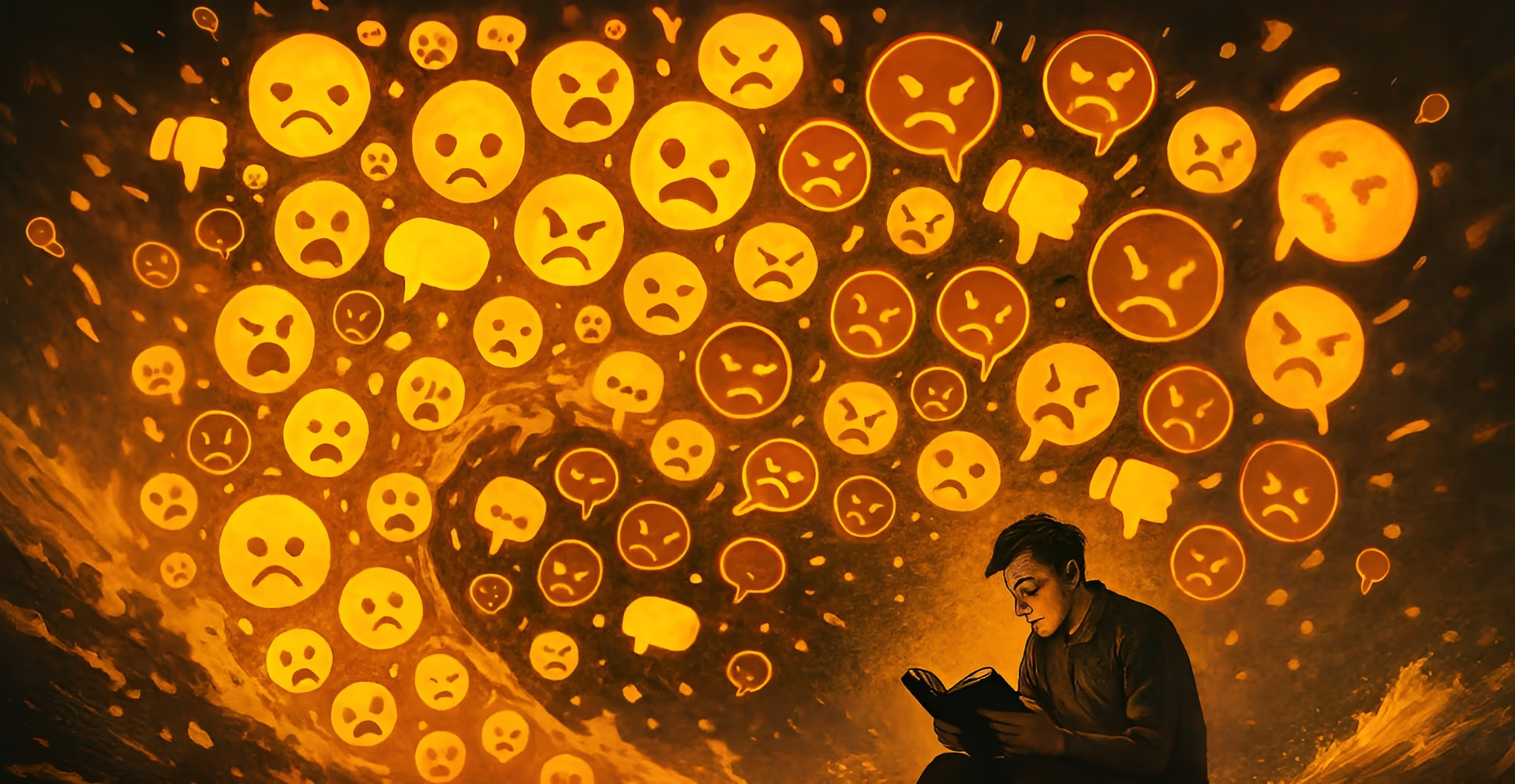
We've democratized opinion-having, and the results are predictably catastrophic.
Somewhere along the way, we convinced ourselves that having access to information was the same thing as understanding it. That reading a Twitter thread qualified you for policy debates. That watching a documentary made you an expert. That feeling strongly about something was equivalent to thinking clearly about it.
"Everyone is entitled to their opinion", we say, as if opinions were some kind of cosmic inheritance - a participation prize for being born with a functioning brain and an internet connection.
But here's the uncomfortable truth: not all opinions are created equal. And treating them as if they were is slowly suffocating genuine discourse.
The Instant Expert Economy
We've built an entire attention economy around the illusion that every thought deserves a platform. Social media has turned us all into publishers, pundits, and public intellectuals - without any of the traditional barriers to entry that once separated casual observation from informed commentary.
The old gatekeepers weren't perfect, but they served a purpose. Editors asked annoying questions like "How do you know this?" and "What's your source?" Publishers wanted credentials, experience, some evidence that you'd earned the right to be taken seriously. These weren't just elitist power plays - they were quality filters.
Now we've torn down those filters in the name of democratization, and we're drowning in the runoff. Every news story generates thousands of hot takes from people who've read nothing but the headline. Every complex issue gets reduced to bumper-sticker wisdom from armchair philosophers who've never grappled with the actual complexity.
The result isn't more wisdom - it's more noise. And in that cacophony, the voices that matter most - the ones built on genuine expertise, careful thought, and hard-won experience - get lost.
The Confidence Inversion
Here's the truly maddening part: the people who know the most are often the most hesitant to speak, while those who know the least can't seem to shut up.
It's a cruel inversion. The expert who's spent decades studying climate science understands the nuances, the uncertainties, the gaps in current knowledge. They hedge their statements, acknowledge complexity, admit what they don't know. Meanwhile, someone who watched a YouTube video yesterday speaks with absolute certainty about global temperature patterns.
The philosopher who's wrestled with ethical frameworks for years approaches moral questions with careful consideration and qualified statements. But the person who skimmed a Twitter thread feels perfectly comfortable making sweeping pronouncements about right and wrong.
Knowledge breeds humility. Ignorance breeds confidence. And our attention economy rewards confidence over accuracy, certainty over nuance, volume over substance.
The Effort Bankruptcy
We've created a culture where having an opinion requires no investment whatsoever. No research, no reflection, no intellectual skin in the game. Just pure emotional response, packaged as thoughtful analysis and fired off into the digital void.
The irony is that we've never had better access to information. Every library in the world is at our fingertips. Primary sources, academic papers, expert analysis - it's all there, waiting. But instead of using these tools to build better opinions, we use them to find quick confirmation of whatever we already believed.
We've confused access to information with engagement with information. We think reading the first paragraph of a Wikipedia article makes us informed. We believe sharing an article we didn't actually read counts as participation in intellectual discourse.
The real work - the slow, difficult process of understanding complexity, weighing evidence, changing our minds when confronted with better information - that's the part we've outsourced to others or abandoned entirely.
The Algorithmic Echo Chamber
Our digital platforms have made the problem worse by optimizing for engagement rather than truth. The algorithm doesn't care if your opinion is well-researched or completely fabricated - it only cares if it generates clicks, shares, and comments.
Controversial takes get boosted. Nuanced analysis gets buried. The person shouting inflammatory nonsense gets a million views, while the expert providing careful context gets a dozen likes. We've accidentally built a system that rewards the worst kind of opinion-having and punishes the best.
The platforms themselves have become opinion factories, churning out endless streams of half-baked thoughts and presenting them all as equally valid contributions to human discourse. We're mass-producing opinions like we mass-produce everything else - prioritizing quantity and speed over quality and thoughtfulness.
The Participation Trophy Problem
Perhaps most damaging of all, we've taught an entire generation that their opinion matters simply because it exists. That having a take is the same as having insight. That expressing yourself is inherently valuable, regardless of whether you have anything worthwhile to express.
This isn't about silencing voices or returning to some gatekeeping elite. It's about remembering that good opinions - the ones that actually move conversations forward, that solve problems, that help us understand the world better - are built, not born.
They're constructed through study, refined through debate, tested against reality, and strengthened through the humbling experience of being wrong. They require intellectual honesty, genuine curiosity, and the courage to change your mind when the evidence demands it.
Rebuilding the Foundation
The fix isn't to stop people from having opinions - that's impossible and undesirable. It's to raise the bar for what counts as a serious opinion worth sharing with the world.
Before you add your voice to the chorus, ask yourself: Have I done the work? Do I understand the counterarguments? Can I explain why I might be wrong? Have I considered perspectives beyond my own experience? Am I contributing signal, or just adding to the noise?
These aren't unreasonable standards. They're not elitist gatekeeping. They're basic intellectual hygiene - the minimum requirements for participating meaningfully in complex conversations.
Because here's what we've forgotten: the right to have an opinion isn't the same as the right to be taken seriously. The right to speak isn't the same as the right to be heard. And the ability to type your thoughts into a phone doesn't automatically make those thoughts worth thinking.
In our rush to give everyone a voice, we've forgotten that some voices are worth more than others - not because of who's speaking, but because of the work they've done to earn the right to be heard.
That's not anti-democratic. That's just honest. And honesty, it turns out, is exactly what our opinion-saturated world needs more of.
No comments yet. Be the first.